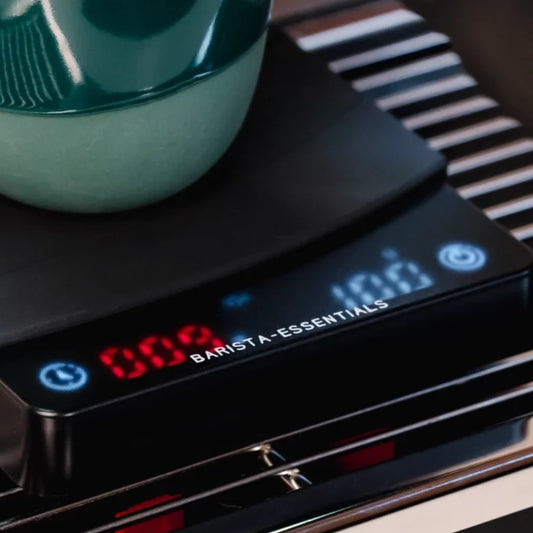
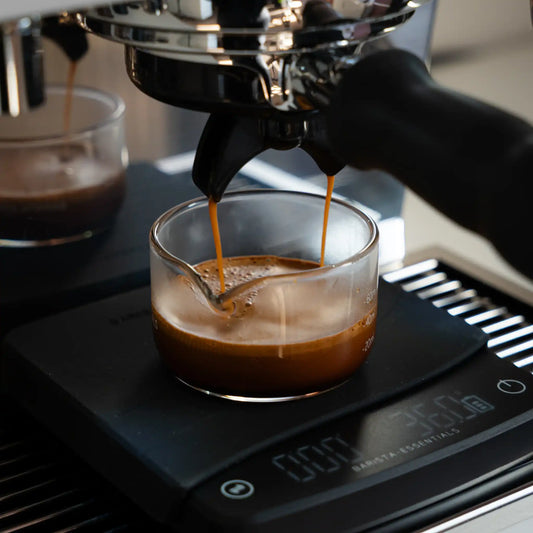
Great espresso starts with measurement rather than guesswork. A coffee scale lets you see exactly how much ground coffee you use, how much espresso ends up in your cup and how long extraction takes.
This collection includes compact espresso scales, models with manual or automatic timers, and espresso shot glasses that give you more control over your coffee. Practical choices for home baristas who want to get more out of their espresso machines.
What is an espresso coffee scale?
An espresso coffee scale is a compact, accurate scale that helps you control three things: how much ground coffee you use, how much espresso ends up in your cup and how long the shot takes to extract.
This matters more for espresso than many home baristas realise. A difference of just a few grams in your portafilter or cup can change the flavour. That's why espresso calls for a barista scale that measures accurately, responds quickly and fits beneath your espresso machine rather than an ordinary kitchen scale.
In this collection, you'll find coffee scales with 0.1 g precision, built-in timers, tare functions, USB-C charging and compact designs, as well as graduated espresso shot glasses.
Why an espresso scale makes such a difference
Many home baristas dial in espresso by feel. They look at the colour, crema or volume in the cup. That might seem logical, but there's a problem: it's hard to repeat an impression consistently.
A scale makes your espresso measurable. You can tell whether you're using the same dose of coffee each time, how much espresso your shot produces and, with a timer, whether extraction runs too quickly or too slowly.
Want to understand the basics better? Read our explanation of why weighing helps you make consistent espresso.
Who is this collection for?
This collection is for home baristas who notice their espresso tastes different from one day to the next: sometimes sour, sometimes bitter, sometimes watery and occasionally just right.
A coffee scale is especially helpful if you:
- want to learn how to dial in your espresso machine;
- want to adjust your coffee grinder more precisely;
- want to rely less on guesswork about dose and extraction time;
- switch to new coffee beans and need to dial in again;
- use a Sage, DeLonghi, Rocket, ECM, Quick Mill, Rancilio, La Marzocco or another semi-automatic espresso machine;
- want to understand why your espresso sometimes runs too quickly or too slowly.
Want to do more than measure and actually understand what the numbers mean? Start with the free introduction to Espresso Onder Controle.
Which should you choose: standard scale, mini scale, auto-timer or shot glass?
Choose a coffee scale with a timer if you mainly want a reliable starting point. Weigh your ground coffee, start the timer and measure how much espresso ends up in your cup. For most home baristas, this is the best first step.
Choose a mini coffee scale if you have limited space under your espresso machine. That's useful for compact machines or smaller coffee corners. A mini scale is also easy to take with you.
Choose a coffee scale with an auto-timer if you want more convenience while brewing. Its automatic functions help streamline your workflow, especially if you make espresso frequently.
Choose an espresso shot glass if you mainly want to collect the espresso, check the volume or examine the crema. However, a shot glass doesn't fully replace a good scale. To dial in accurately, you need both weight and time.
Why De Barista Shop recommends these tools
At De Barista Shop, the goal isn't to collect as many barista accessories as possible. It's to choose tools that help you make better coffee.
An espresso scale is one of those tools. Not because coffee has to be complicated, but because measuring takes the guesswork out of brewing. You can see what's happening, and once you can see it, you can learn how to adjust it.
That's also why this collection fits naturally with Espresso Onder Controle. There, you learn step by step how coffee beans, grind size, extraction, time and brew ratio work together to determine what's in your cup. Want a deeper understanding of inconsistent espresso? Explore the espresso extraction and control collection.
Make your scale part of a consistent espresso routine
A coffee scale works best as part of a regular routine. Weigh your beans or ground coffee. Distribute the grounds evenly in your portafilter. Tamp as consistently as possible. Place your cup or shot glass on the scale. Start your timer. Measure the final espresso weight.
This is how you build repeatability.
A scale also works well alongside:
- fresh coffee beans;
- a dosing cup or dosing ring;
- a good tamper;
- a graduated shot glass;
- a cleaning routine;
- an online module about extraction;
- a barista workshop at home.
Just started using an espresso machine and wondering which tools are genuinely useful alongside a scale? Also see our selection of barista tools for beginners.
Personal help with dialing in espresso
A scale gives you numbers, but those numbers are only useful when you understand what to do with them.
Is your espresso running too fast? You may need a finer grind. Is it running too slowly? You may need a coarser grind. In practice, the dose, beans, freshness, distribution and tamping also play a part.
Want to learn this using your own espresso machine and grinder? A private barista workshop in your home is the quickest way to learn. Geert-Jan works with your setup, workflow and coffee so you understand not just what to adjust, but why.
Advice from De Barista Shop
Don't buy a coffee scale just because it looks 'professional' next to your machine. Buy one because you want to make less guesswork part of your home routine.
For most home baristas, a coffee scale with a timer is the best first choice. If space is limited, choose a mini model. If you make espresso frequently and want extra convenience, an auto-timer model makes sense. A shot glass is useful for collecting, measuring volume and pouring, but isn't a full substitute for a scale.
Start simply: measure your dose, your espresso yield and your time. Fine-tune only after that.
Frequently asked questions about espresso coffee scales
Do I really need a coffee scale for espresso?
Yes, if you want to make more consistent espresso at home. Without a scale, you don't know exactly how much coffee you're using, how much espresso you're making or whether your extraction time is on target. You're mostly working by feel.
What's the difference between a coffee scale and a kitchen scale?
A coffee scale is more compact, accurate and responsive. For espresso, you generally want 0.1 g increments, a fast response time and preferably a built-in timer. Ordinary kitchen scales are often too slow or too large.
Which coffee scale should a beginner choose?
For beginners, a coffee scale with a timer is usually the best choice. It lets you learn the fundamentals straight away: measuring dose, yield and extraction time. That's enough to make dialing in espresso much easier.
Do I need an auto-timer?
Not necessarily. An auto-timer is mainly about convenience. It helps if you make espresso often and want a smoother workflow. A regular timer is perfectly adequate for learning and dialing in.
Can I use only an espresso shot glass?
A shot glass is useful for collecting espresso, checking volume and observing the crema. But a shot glass alone isn't enough for precise adjustments. Weight is more reliable than volume because crema can distort the volume reading.
Will a coffee scale fit under every espresso machine?
That depends on the clearance between the drip tray and portafilter. With compact machines, a mini scale is often more practical. If in doubt, measure the space beneath your portafilter before choosing.
An espresso coffee scale is one of the most useful tools for home baristas who want to brew consistently. With a timer-equipped scale, you can measure not just your dose of ground coffee but also the espresso yield and extraction time. This helps you dial in your grinder more systematically and understand why your espresso tastes sour, bitter, watery or nicely balanced.
At De Barista Shop, you'll find coffee scales, barista scales, mini scales, auto-timer scales and espresso shot glasses suited to home use. They're not just gadgets, but practical tools for learning how to use your espresso machine more effectively.