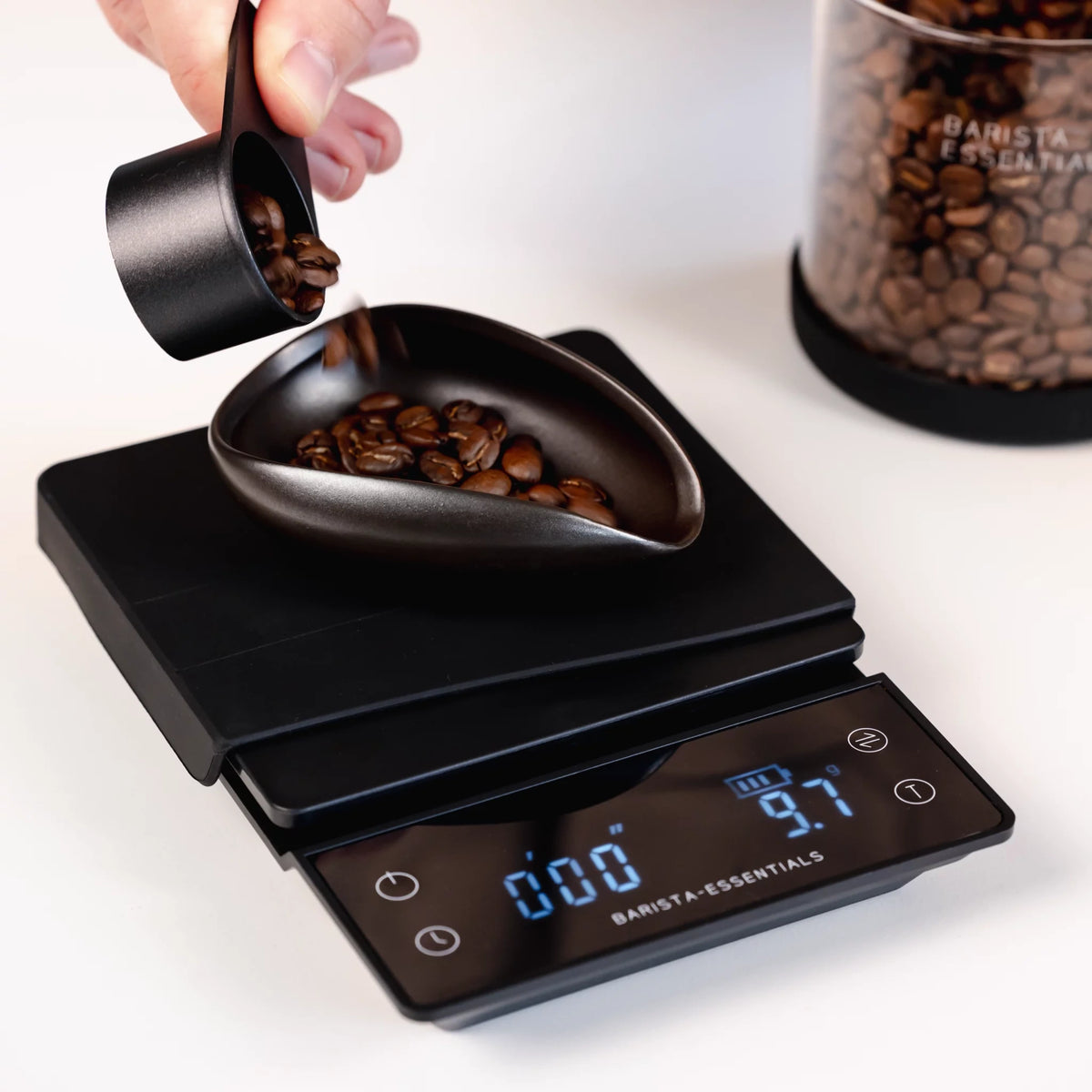
Check the dimensions of 183 Γ 129 Γ 27 mm plus the height of your cup beneath the spout; splash-resistant does not mean submersible.
Coffee Scale with Timer | Barista Essentials
Does your espresso taste different each time, even when you use the same beans? With the Barista Essentials coffee scale with timer, you can measure how much ground coffee you use, how much espresso ends up in your cup and how long the extraction takes. This helps you compare results and make targeted adjustments. Before ordering, check whether the scale and your cup fit underneath your machineβs spout. You order from Barista Essentials.
- Weigh your coffee and espresso with a stated precision of 0.1 gram.
- Track brewing time with the built-in timer.
- Rechargeable via USB-C, with a non-slip mat for more stable weighing.
This link takes you to Barista Essentials; De Barista Shop may receive a commission when you order. You purchase from Barista Essentials, which also handles payment, shipping, returns and warranty.
View full details

Key specifications
-
Brand
Barista Essentials
-
Product type
Digital coffee scale with manual timer
-
Size / Content
Digital coffee scale with manual timer
-
Suitable for
No confirmed fit for specific machine models; check drip tray space and clearance with your own cup.
-
Material / finish
Not specified by Barista Essentials.
-
Cleaning / Maintenance
Barista Essentials does not specify a product-specific cleaning method. Do not immerse the scale and keep the USB-C port dry; ask for care instructions if in doubt.
-
Colour
Black
-
Package contents
Coffee scale with timer, non-slip mat and USB-C charging cable.
Why this helps make better coffee
You fill the filter basket with ground coffee, tamp it and start the machine. Yesterday your espresso tasted good, but today it tastes sharp, thin or bitter. Yet it seems as though you did exactly the same thing.
The problem is that small differences are hard to see. A slightly fuller basket contains more coffee. Brewing for a few seconds longer puts more espresso in your cup. And if you judge only by the level in the cup, you also count the crema on top. That layer can vary between coffees and shots.
This makes it easy to compare two espressos that are less alike than you think. You then adjust the grinder, use a little more coffee or stop the machine earlier. If you change several things at once, it becomes difficult to discover which adjustment actually helps.
Filter coffee presents a similar challenge. A scoop of coffee is not a fixed quantity, and filling a water jug by eye makes a recipe hard to repeat. To understand why one cup tastes stronger or more pleasant than another, it helps to make what you use and what you do measurable first.
A coffee scale makes three important parts of your espresso measurable:
How much ground coffee you use. This is your dose: the weight of the coffee in the filter basket.
How much espresso you make. This is your yield: the weight of the drink in your cup.
How long brewing takes. This is your brewing time: the time you track consistently during extraction.
Looking at these measurements together makes comparisons fairer. If you use the same dose each time and stop at the same beverage weight, it becomes clearer what an adjustment to your grinder does.
For example, you use 18 grams of ground coffee and produce 36 grams of espresso. That is approximately two grams of beverage per gram of coffee, a 1:2 ratio. It is a useful starting point for many double espressos, not a compulsory recipe for every bean or basket.
The timer then helps you record how long that recipe takes. If the same yield suddenly takes much less or more time, that is a clue to check your routine. Then taste to see whether an adjustment actually improves the result.
Want to understand how weight, time and flavour relate? In The 3 Golden Rules of Espresso you learn how to use these measurements to adjust your espresso more deliberately.
For filter coffee, weighing helps you maintain the ratio of ground coffee to poured water. The timer lets you compare how the brewing progresses. The same rule applies: measuring gives you a reference, but tasting determines whether the recipe suits your coffee and preferences.
More confidence when weighing and comparing, so you can work more deliberately towards espresso that suits your taste.
Who is this suitable for?
This scale is a sensible starting point for home baristas who want to stop dosing and ending the shot by guesswork.
You are starting out with espresso
You do not need to know complicated recipes yet. Start with the weight of your ground coffee, the weight of your espresso and the time you measure. This helps you build a process you can repeat next time.
Your espresso varies for no obvious reason
Using roughly the same amount of coffee each time does not tell you whether the quantity is actually consistent. Weighing helps you rule out that difference before adjusting your grinder again.
You want to dial in your grinder more deliberately
Grind size determines how finely or coarsely your grinder grinds the beans. With consistent weights and a measured brewing time, you can better observe what a small adjustment does.
You want simple controls
This version suits someone who wants to track weight and time themselves and operate the timer manually. You do not need an automatic measuring function for that.
You also want to weigh coffee away from the machine
You can weigh coffee on your countertop, provided the container or portafilter stands steadily on the weighing platform. To weigh during espresso extraction, there must also be enough space on the drip tray and below the spout.
For whom is this not necessary?
You want the timer to start automatically
This is the basic version with a manually operated timer. If you want the timer to start automatically, first compare it with a version designed for that. Automatic operation is mainly about convenience; you do not need it to learn to work with consistent weights.
You have little room beneath the spout
A scale may fit on the drip tray but leave too little room for your favourite cup on top. Measure the whole combination. If space is tight, a smaller version may make more sense; check the current dimensions before choosing.
You already have a reliable scale
If you can already track coffee and beverage weight reliably and have a usable timer, a new scale is not automatically your most useful purchase. Understanding your recipe better may provide more value than buying another device.
You expect weighing to solve the flavour automatically
This scale does not change your coffee beans, grind or brewing temperature. It helps you measure. To understand these numbers and put them to good use, Start with Espresso Onder Controle may be a better first step.
Does this fit your machine, routine or use?
-
Compatibility
A coffee scale does not need to connect to your espresso machine. Whether you can use it during brewing mainly depends on the available space.
1. Check the space on the drip tray. The scale needs to stand flat and stable. Allow for dimensions of 183 Γ 129 mm.
2. Check the clearance below the spout. The scale is 27 mm high. Your cup must fit above it, with enough room to move it in and out without bumping anything.
3. Check access to the display and buttons. You need to be able to read the weight and operate the timer while brewing.
Measure with the cup you actually plan to use. A low espresso cup may fit where a taller cappuccino cup leaves too little space. If using two cups, also check that both stand securely and catch the espresso.
If you want to set the portafilter on the scale to weigh ground coffee, check that it stays in place without support. Do not hold it during weighing: doing so affects the reading.
No specific machine-model fit is promised here. A smaller scale is often more practical if the drip tray is small or headroom is limited.
-
Size
183 Γ 129 Γ 27 mm
-
Machines and painters
Not tied to a particular machine; check the available space under the spout.
-
Specifications
Not tied to a particular machine; check the available space under the spout.
Advice from Geert-Jan the Barista Man
With over 10 years of experience in providing barista workshops at home, at businesses, and in Amsterdam, Geert-Jan is happy to share his advice.
From practice:
Geert-Jan de Baristaman explains why weighing helps: you can only make meaningful comparisons when you know how much coffee you use and how much espresso you make from it.
My advice:
My advice: choose this scale if you want a simple foundation for tracking coffee dose, espresso yield and brewing time together. If you currently fill the filter basket by eye and stop the machine when your cup looks full enough, this gives you useful additional information.
Then start small. Choose a dose that suits your basket, keep it constant and decide on the beverage weight at which to stop. Record the time and taste the result. You do not need to invent a new recipe for every espresso.
Only buy this version if it fits below the spout with your cup and you want to operate the timer yourself. A smaller model may be more convenient when space is tight. Automatic timing can be useful, but it does not automatically improve your recipe.
Already have a suitable scale but your espressos still vary? Focus first on understanding what you measure. The 3 Golden Rules of Espresso directly addresses working with coffee weight, beverage weight and time.
Geert-Jan de Baristaman
Here's how to use this in your coffee routine
A barista tool only really works well when you know where it fits into your routine.
Get into the routine:
Weighing
Usage:
Weighing
Geert-Jan's tip:
Record three measurements: grams of ground coffee, grams of espresso and the measured time. Then add a short tasting note, such as 'sharp and sour', 'dry and bitter' or 'pleasantly balanced'.
Time alone does not tell you enough. An espresso yielding 20 grams in 28 seconds is a different recipe from one yielding 40 grams in the same time. Recording the weights as well prevents you from treating different preparations as identical.
Use the same beans and cups for your next attempt. This makes comparison easier and helps you avoid changing too many things at once.
Note:
View the scale at Barista Essentials
Common mistake
View the scale at Barista Essentials
Learn what your coffee weight and brewing time tell you
Measuring is a good first step. The next step is understanding which adjustment makes sense when your espresso runs too quickly, tastes sharp or turns out differently each time.
In The 3 Golden Rules of Espresso, you learn to work with the weight of ground coffee, the weight of the espresso and the time you measure. This gives your scale a clear place in your daily routine.
Are you starting from scratch or still missing an overview? Begin with the free introductory course Start met Espresso Onder Controle. It helps you decide where to begin and how to continue learning.
Learn how to use coffee weight, espresso yield and brewing time together to adjust your espresso more deliberately.
The 3 Golden Rules of Espresso β Why Your Shots Keep Changing (and How to Stop It)
As a beginner, build an overview before changing individual settings or buying additional tools.
Start with Espresso Under Control β free introduction to better espresso at home
Frequently Asked Questions
Am I buying this scale from De Barista Shop or Barista Essentials?
You buy this scale from Barista Essentials. The button takes you to their store, where you can check the current price and availability and place your order.
De Barista Shop provides explanations and buying guidance. Payment, shipping, delivery, returns, warranty and any complaints about your purchase are handled by Barista Essentials. Check their current return conditions and any applicable right of withdrawal there.
Why is there an affiliate link for this scale?
This link lets Barista Essentials recognise that you arrived through De Barista Shop. De Barista Shop may receive a commission if you go on to order.
No price promise is made about ordering through this link. Check the current product price, any discount and shipping costs at Barista Essentials before paying.
Will this scale fit under my espresso machine?
That depends on the space on your drip tray and the height between the tray and the spout. Measure both before ordering.
The stated dimensions are 183 Γ 129 Γ 27 mm. Add the height of your cup to the scale's height and leave enough room to move the cup in and out.
Also check that the scale can stand flat and that you can use its display and buttons. Simply establishing that it fits on the drip tray is not enough. Short on space? Compare a smaller version.
Does the timer start automatically, and do I need batteries?
On this basic version, you operate the timer yourself. Start it when you begin brewing with the machine and use the same starting point every time.
You do not need to insert separate batteries. Barista Essentials recommends charging this scale using the supplied USB-C cable. The presence of a battery compartment cover therefore does not mean you need to buy batteries first.
If you want automatic timing, choose a version that explicitly offers that function.
When should I consider something else before buying this scale?
If you already have a reliable scale for weighing coffee and espresso, you do not need to replace it straight away. A separate timer may be enough to practise with consistent recipes.
If you mainly do not know what to do with the measured weights and times, start with Start with Espresso Onder Controle or explore The 3 Golden Rules of Espresso.
If this version does not fit well under your machine, choose a more suitable size first. And if you cannot adjust your grind, do not expect a scale to solve that limitation. It shows you what is happening, but does not adjust your grinder or machine for you.
I have another question
You can always contact Geert-Jan de Baristaman
Know how much coffee goes in and how much espresso comes out
You order from Barista Essentials; De Barista Shop may receive a commission through this link. Barista Essentials handles payment, delivery, returns and warranty.