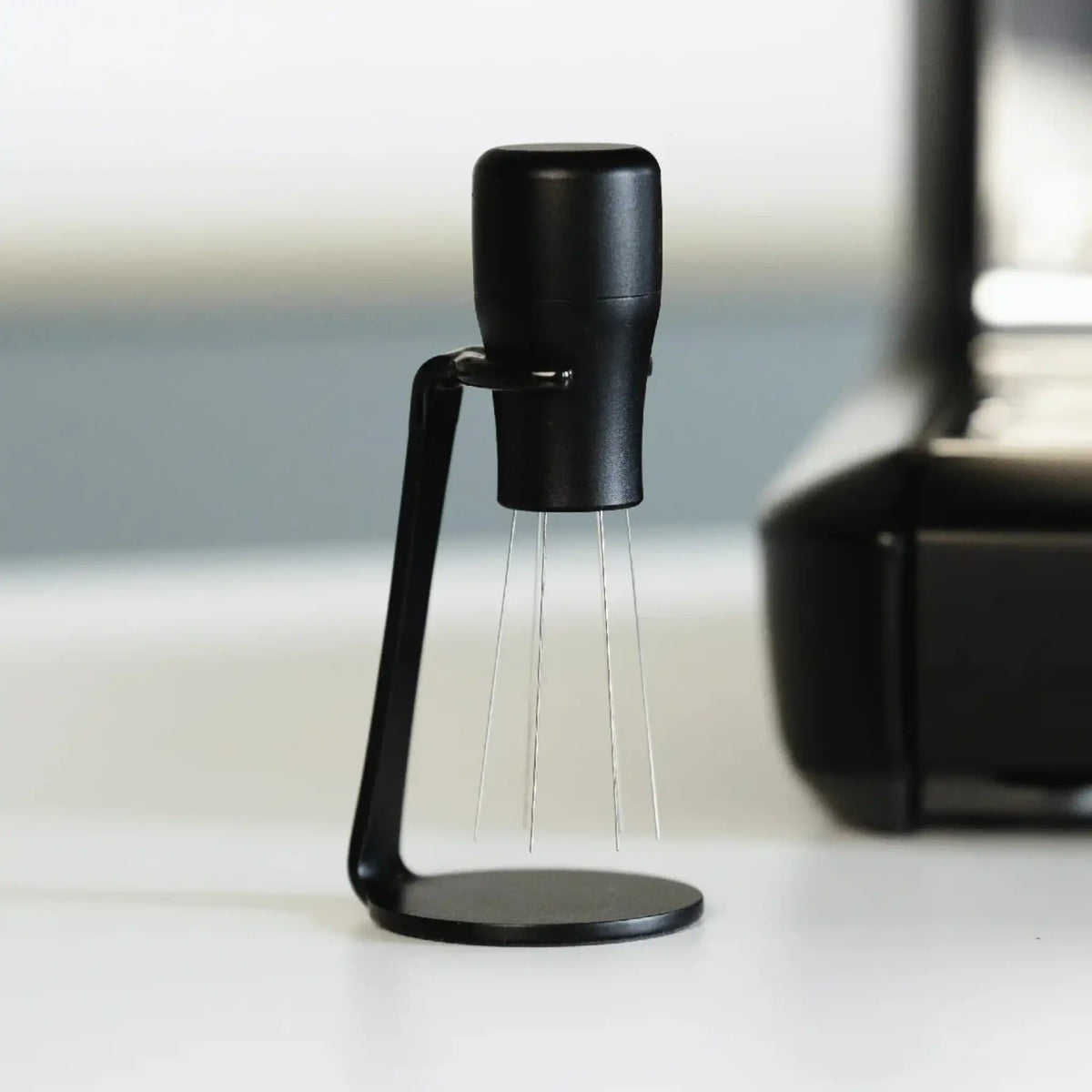
To gently stir ground coffee

After use, put the tool away in a fixed location

Replaceable needles according to the supplier

A compact tool for preparing espresso

Zwarte WDT-tool in de meegeleverde zwarte houder

What do you see after grinding?

You grind coffee for an espresso and look in the filter basket. Sometimes the coffee is loose, other times there are small clumps or more coffee on one side. If you tamp immediately, you can no longer easily change that distribution. So look at the coffee first before adding an extra step.

  • Small lumps in the grind

    After grinding, some of the ground coffee remains stuck together. As a result, not all of it falls into the filter basket as loose coffee.

  • An uneven layer of coffee

    The ground coffee is higher on one side. A level top also does not always indicate how evenly distributed the coffee is underneath.

  • Inconsistent flow rate with espresso

    One espresso may flow differently from the next. This can be due to distribution, but also to dosing, grind size, or other causes.

Zwarte WDT-tool roert door gemalen koffie in een filterbakje met doseerring

Break up lumps before pressing.

WDT is a method of distributing coffee using thin needles. With this tool, you gently move through the ground coffee so that visible clumps break apart. Then you remove the tool from the basket and tamp as you normally do.

Does coffee spill over the edge while stirring? Then look for a suitable dosing ring. Check the size of your filter basket beforehand. A WDT tool does not replace your tamper.

When is a WDT tool useful?

For the home barista with a loose portafilter who sees clumps after grinding and wants to distribute the coffee before tamping. Choose the version with a holder if you want to store the needles neatly. If your coffee is already loose and even, WDT doesn't need to become an extra permanent step.

What exactly do you get?

This is the black Barista Essentials WDT tool with holder. The tool has a lightweight aluminium handle and interchangeable 0.35 mm needles. According to the manufacturer, four spare needles are included.

The black holder is part of this version. It is intended for placing the tool down after use, not for distributing the coffee. This is therefore not the separate holder or the version without a holder.

First, look at what your mill does

My advice is to first observe a few times how the ground coffee ends up in the basket. If you see small clumps, try gently stirring them loose. Start at the bottom of the coffee layer and work your way up. You don't need to move it for long or vigorously.

A WDT tool does not make your grind finer or change the amount of coffee. An uneven extraction can therefore have other causes as well. When comparing, keep the dose and grind size as consistent as possible.

If you mainly want to be able to set the tool down neatly, then this version with a holder makes sense. If you already have a suitable place, also take a look at the black WDT tool without a holder.

Stir the lumps until they dissolve, but keep tasting your own espresso.

Zwarte WDT-tool in de meegeleverde zwarte houder

How to use a WDT tool for espresso

Use the tool between grinding and tamping. Your goal is to break up any clumps in the coffee bed, not to add as many steps as possible.

With a suitable dosing ring you can keep the coffee better contained while stirring. Remove it before tamping if that is necessary for your workflow.

View the WDT tool with holder
  • Stap 1: Een man geniet thuis van koffie bij het keukenraam, met een groot cijfer 1 op de voorgrond.

    Inspect the coffee after grinding

    Measure your usual dose into the filter basket. Place the portafilter firmly on its base and check for clumps or a high mound of ground coffee.

  • Stap 2: Een man leest thuis de krant met een kop koffie, met een groot cijfer 2 op de voorgrond.

    Stir with small, gentle movements

    Carefully move the thin needles upwards from deeper in the coffee. Break up clumps without scraping hard against the bottom or side.

  • Stap 3: Een espressomachine bereidt thuis een kop koffie, met een groot cijfer 3 op de voorgrond.

    Remove the tool and tamp

    What to do at step 3?
1 of 3

About clumps, machine fit, the holder and use before tamping.

Frequently asked questions about the WDT tool with holder

What does a WDT tool do with ground coffee?

You move a WDT tool with thin needles through the ground coffee in your filter basket. This loosens clumps and distributes the coffee before tamping. It is a preparation step, not a coffee grinder or tamper.

Does this WDT tool fit my espresso machine?

You use it in a separate filter basket, not as a part that clips onto the machine. That is why you do not choose based on a fixed tamper diameter. You must have enough space to move carefully through the coffee. With capsules or a superautomatic machine, this separate preparation step is generally not part of the process.

What is the benefit of the included holder?

We're here to help you get the most out of your water sports adventures. Below, you'll find answers to some of the most frequently asked questions.

How thick are the needles and are there spares?

Barista Essentials states that it has interchangeable 0.35 mm needles and four spare needles. You can open the handle to replace a needle. Handle the points with care and follow the manufacturer's instructions.

Does a WDT tool automatically make better espresso?

No, you cannot promise that for every espresso. WDT helps if you want to break up clumps in ground coffee. The taste and flow also depend on the beans, grind size, dose, and tamping. At the official WDT tool from Barista Essentials you will find the product details and the different versions.

I have another question...

WDT tool black with holder for espresso

If you see clumps in your ground coffee after grinding, a WDT tool can help distribute them. Gently stir the thin needles through the coffee grounds before tamping. This breaks up clumps and allows you to work with a more evenly prepared puck. This black WDT tool from Barista Essentials comes with a holder, has interchangeable 0.35 mm needles, and includes four spare needles. Before buying, check whether you make espresso using a separate filter basket that allows you to perform this step. This way, you are buying a tool for a specific problem, rather than just another unnecessary gadget for the countertop.

Prevent clumps in ground coffee and distribute evenly

Preparing an espresso doesn't start with tamping. First, check the grind: how much coffee are you using, does it fall freely into the filter basket, and are there any visible clumps? If everything is neatly and evenly distributed, you don't automatically need to add an extra step to every espresso. If you do see clumps, you can break them up with the thin needles of a WDT tool.

Start gently at the bottom of the coffee bed and work your way up. You don't need to apply force or stir for long. Once the coffee is distributed, lift the tool and tamp as you normally would. If you want to support the portafilter in a fixed position while tamping, see if a flat silicone tamping mat suits your workflow.

The holder on this black version is particularly practical after use. You can place the WDT tool with the needles in a fixed position so it doesn't lie loose among other items. If you are only looking for a tool to distribute clumps, there is also a black version without a holder. Both versions perform the same preparatory work on the coffee.

My advice: when comparing two espressos, try to change only one thing at a time. Keep your dose and grind size the same and see if the preparation step helps you. The black WDT tool with holder is a logical choice when you want to tackle clumps and store the tool close to your espresso machine.